Confused by skincare labels? This guide will explain the ingredients, symbols, and product claims so you can easily choose safe and effective skincare products.
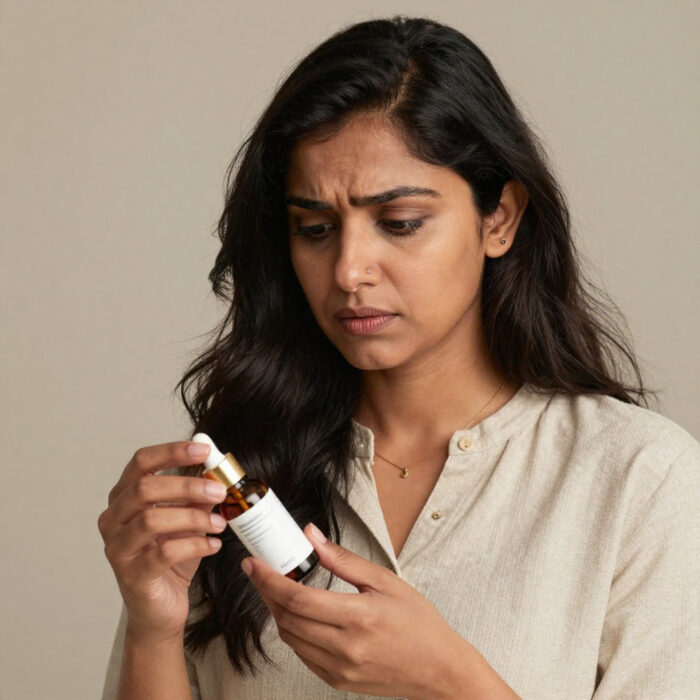
Ever picked a costly serum and flipped it over, only for it to make your head go round? Those labels are supposed to explain what the product is but somehow they just end up making things worse.
Maybe the product that you were using was a gentle, ‘dermatologist-approved’ cleanser, but your skin got all red and swollen?
This might be happening because you’ve been reading your labels wrong or you have been trusting the wrong ones. And no, understanding skincare labels isn’t rocket science.
And to ensure that you make better skincare decisions, we will explain how to read skincare labels and what they mean:
Table of Contents
Key takeaways
- INCI lists ingredients by concentration which helps you identify the actives and potential irritants easily.
- Claims like dermatologist-tested, natural, or non-comedogenic are unregulated and mostly marketing-driven, and are not guarantees of effectiveness.
- Fragrance-free differs from unscented, there are masked fragrances in unscented products that can still irritate sensitive skin types.
- Standardized symbols like organic certifications, batch numbers, POA, and best-before dates provide reliable product information.
- Choose skincare by ingredients and proven actives, patch test first, and introduce new products gradually.
The INCI list meaning
See that long list on the back of the products which seems something straight out of a chemistry class?
It’s the INCI (International Nomenclature of Cosmetic Ingredients) list – a globally standardized system for the classification of ingredients used in cosmetic and skincare products.
This list features the Latin name botanical components and scientific names of the chemical components (hence, it feels hard to read).
The INCI list follows one main rule – it’s an ordered list. All the stuff there in the formulation is listed in descending order of concentration.
The ingredient used the most in concentration is mentioned first and what comes last is the least used. Don’t be surprised if you find ‘Aqua’ listed first, as it’s water and it makes up most of the skincare products out there.
But there is one exception to this rule, often called the ‘1 percent rule.’ This says that ingredients that make up less than 1% of the product can be listed in any order.
And no matter how minute the ingredient is, a brand cannot skip mentioning it. The cosmetic rules act, 2020 mandates that any special ingredients (like potential allergens) need to be disclosed on the product.
Busting tags and marketing claims
Skincare labels say ‘all natural’ as if it came straight from the Himalayas. And most of us even believe it. However, labels like these are not regulated and are often disguised as marketing claims.
Let’s look at a couple of them:
Dermatologically-tested meaning
We always buy on the basis of phrases like dermatologically-tested. But do you know what it actually is? It just means that some dermatologist has evaluated the product, not that it is approved by an official agency.
Brands do not even need to consider any rigorous testing for labels like this since they are not actually regulated by law. This label is just half information and doesn’t truly paint a picture about the product.
Fragrance-free vs unscented
These two words feel the same, right? However they are not. Fragrance-free means that the product lacks any scents, no strings attached.
While unscented means they are masked fragrances present. And this little change of words can make a lot of difference, especially when you have sensitive skin.
Alcohol-free label
You might have seen one of these on perfumes or skincare. But an alcohol-free label doesn’t literally mean what it says.
The alcohols it talks about are drying alcohols – the ones which make your skin irritated. But, products might still contain fatty alcohols which work as moisturizers.
Non-comedogenic label
Unlike how scientific it sounds, this name is not based on any rigorous tests. Non-comedogenic refers to skin products that won’t clog your pores.
Since this term is not regulated, brands can just self-declare their products as non-comedogenic without any appropriate evidence.
Paraben-free symbol
The paraben-free symbol is omnipresent in skincare. And, it’s often misunderstood as a product lacking preservatives.
However, being paraben-free just refers to a product lacking parabens like synthetic preservatives like propylparaben and methylparaben. It basically means that your products will still have preservatives (or else it will grow molds like leftover bread).

More Great Wellness Stories From dewique
- How to Take Care of Your Skin While Doing a 9-5 Job
- Natural Moisturizers You Should Try This Winter To Combat Dryness
- Oily in Summers and Dry in Winters? 10 Tips for Dehydrated Oily Skin
- Pop it or leave it? How to treat acne without leaving scars
- How to Keep Your Skin Fresh and Acne-Free After Every Workout with Proper Post-Workout Skincare
- Is Winter Pollution Destroying Your Skin? 5 Simple Steps to Pollution-Proof It Now
Standardized symbols
Now, let us decode the symbols printed on your products. And unlike those self-proclaimed labels, these are actually standardized:
Cruelty-free symbol
Cruelty-free symbols mean that there has been no animal testing at any stage of manufacturing. Indian law doesn’t require any such certification, since animal-testing in cosmetics is outrightly banned.
But if you see the leaping bunny symbol or PETA’s ‘Beauty without Bunnies’, then it is just extra assurance.
Organic certification symbols
Organic certifications show that the products you are using have ingredients sourced organically, and have minimal synthetic chemicals.
The common certifications include the USDA organic seal, COSMOS (Cosmetic Organic and Natural Standard), or Ecocert certification. These logos aren’t just some marketing noise, but actual verified claims made by organizations.
Batch number meaning
Ever seen the bar code on the back of the product? That is the batch number, which is a code that tells us when, where and by whom a product was manufactured.
It comes in alpha-numeric form and is important for quality control.
Period after opening symbol
A POA (period after opening) sign tells us the period of time we can use a product for after it has been opened. It is shown as a small open jar marked with a number followed by M.
This number is the shelf life of the product after opening.
Best before dates
The best before date cosmetics show the shelf life of the product. Is it the same as POA?
Well, no.
POA shows the duration you can consume it after opening. On the other hand, best before dates shows the duration until you can use an unopened product.

How to choose the right skincare product?
Now, you know what your skincare packaging actually says. Further, let us look at how to choose the products the right way:
Look at the INCI list
After you find a product, the very first step would be scanning through the ingredient list. It is where you will know what you’re actually putting on your skin.
Make sure there are not any irritants like fragrance or dry alcohols. Let tools like INCI decoder simplify the complex things for you!
Look out for any misleading claims
Don’t be fooled by companies branding their products as ‘dermatologist-approved,’ ‘natural,’ or ‘paraben-free’.
None of these terms are regulated by law, and they are more likely to be marketing tactics. Always look at the ingredient list and labels like organic certifications instead.
Target formulations with actives
Don’t let yourself flow with labels like ‘botox-like results,’ instead look for active ingredients that actually deliver results.
Look at your key skin concerns and get an appropriate formulation – glycolic acid for tanning, salicylic acid for oily skin, vitamin C for brightening and niacinamide for sensitive skin.
Gradual incorporation
Whenever you choose a new product, don’t just start using it actively right away.
First, do a patch test to make sure your skin doesn’t irritate. Then, incorporate it gradually by using it 2-3 times a week. Make the use more frequent as your skin adjusts.

Conclusion
The whole cosmetic industry is counting on you taking the labels at their face value. They make bold promises, and expect you to believe them. But now you know to read skincare labels, evading their marketing tactics like a pro.
So, read the product label carefully, and always make sure to run the ingredient list through the INCI decoder. Spot the BS, and look for products that will actually work for your skin.
Your face and bank account will both be grateful when you stop buying products that are all bark and no bite.
And if you want more helpful tips like these, talk to Dewi – our AI-powered skincare advisor.
Frequently asked questions
1. Can products be labeled ‘natural’ and still contain harmful chemicals like sulphates?
Yes, it’s because the term natural is not regulated and brands use it freely. Thus, you should always check the INCI ingredient list.
2. Why do fragrance-free products still smell?
Ingredients have natural scents. The tag fragrance-free means there has been no added scents. But it doesn’t mean that smells cannot be present.
3. Do serums with actives listed at the end actually work?
An active being listed last means it has an extremely low level of concentration, so it might not effectively treat your skin concerns.
4. How long does a sunscreen remain effective after opening?
Most sunscreens last 12 months after opening but you might have to check the PAO symbol on your product.
5. Does the ‘dermatologist-approved’ tag make a product better?
No, ‘dermatologist-approved’ just means it has been reviewed professionally. That means there is no guarantee that it will actually work for you.
If you would like to see our shared skincare tips in more formats, please follow us on Instagram, where we share daily tips and useful skincare advice.